




16. 10. 2026, 7 p.m.
Reduta Theatre – Mozart Hall
Tenor: Aleš Briscein
Alto: Michaela Zajmi
Piano: Kryštof Mařatka
Clarinet: Yan Mařatka
Viola: Karine Lethiec
3 female voices
16. 10. 2026
7 p.m.
Reduta Theatre – Mozart Hall
Tenor: Aleš Briscein
Alto: Michaela Zajmi
Piano: Kryštof Mařatka
Clarinet: Yan Mařatka
Viola: Karine Lethiec
3 female voices

Leoš Janáček: Nursery Rhymes (1925–26) / world premiere of a new version for 1–2 voices, clarinet and piano, arranged by Kryštof Mařatka (2025–26)
Kryštof Mařatka: Altotem / nocturnal archaic music for viola with piano accompaniment (Czech premiere)
Kryštof Mařatka: Pastoral Fables / composition for viola, clarinet, piano, and Czech and Moravian folk instruments
–
Kryštof Mařatka: The Mystery of Mr Rybka / melodrama for one comedian (and one) pianist, based on a short story by Karel Čapek
Leoš Janáček: The Diary of One Who Disappeared, JW V/12 / song cycle for tenor, alto, three female voices, and piano
While Janáček’s music has its roots in Moravian folk music, Kryštof Mařatka (b. 1971) is inspired by the ethnic music of several continents.
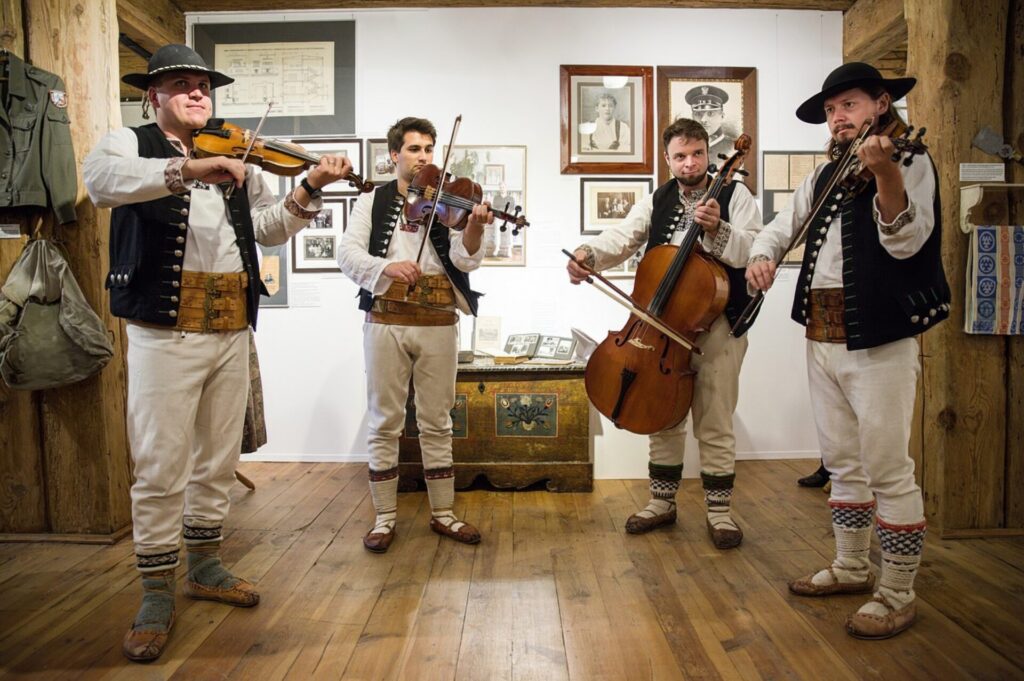
Kryštof Mařatka’s 2016 composition Pastoral Fables is inspired by the world of folk music and its instrumentation, which the author uses in confrontation with other instruments. It features instruments such as the elderberry pipe, chamois horn, ragman’s whistle, nose flute, shepherd’s horn, and bone flute.
Mařatka found the inspiration for his 2015 melodrama The Mystery of Mr Rybka in Karel Čapek’s short story Footprints (Šlépěje), published in Tales from One Pocket (Povídky z jedné kapsy). The text and plot play a crucial role here, forming the basis for the musical arrangement; however, the music does not possess a dominant function but rather complements the narrative. The piece is part of a series of the composer’s other melodramas for the same instrumentation, forming a unified whole. It was originally intended for a single performer: an actor-pianist who takes on both roles—the acting performance and playing the piano—but the piece can also be performed by two interpreters: one actor and one pianist. The text can be performed in various languages. The atmosphere of mystery, which is the theme of Čapek’s short story, is underlined by the microtonal color of chords in the piano part, achieved by the composer in his own rather unusual way, thus creating space for the content of the writer’s text, which touches upon the inexplicability of certain phenomena surrounding us.
The composition Altotem, nocturnal archaic music for viola with piano accompaniment, is inspired by key collections of a leading French institution that exhibits treasures of the past and the origins of human activity in general: the National Archaeology Museum in Saint-Germain-en-Laye near Paris. The composer states that in his imagination, the altotem is an imaginary ancient and forgotten musical instrument, a kind of predecessor to the modern viola, which, through its performance with archaizing and unusual acoustics, protects the museum’s collections, watching over them and holding a protective hand. This is also the origin of its name, composed of two parts: alto as in viola, and totem, a symbol of protection and patronage.
Leoš Janáček (1854–1928) treated himself to the playful folk Nursery Rhymes shortly after his seventieth birthday. These years are typical for the composer, among other things, for their remarkable chamber instrumentation (Nursery Rhymes, Concertino, Capriccio). As he had several times before, he drew inspiration from his favorite newspaper, Lidové noviny, where short rhymes illustrated with pictures by Josef Lada, Ondřej Sekora, and Jan Hála were published in the children’s section Dětský koutek. In 1925, Leoš Janáček wrote the first version of Nursery Rhymes: 8 short musical numbers for 1–3 voices, clarinet, and piano. A year later, he created the second version: expanding the piece to a total of 19 numbers and significantly broadening the instrumentation to 9 voices and a larger instrumental ensemble. The Universal Edition publishing house created a version of the piece for voices, viola, and piano, which, however, the composer did not authorize. The present 2025–2026 version of Nursery Rhymes is a combination of both of Janáček’s original 1925 and 1926 versions. In length and form, it corresponds to Janáček’s second “large” version with 19 musical numbers, but its instrumentation is based on Janáček’s initial concept of the first version for voice(s), clarinet, and piano. This creates a new, more extensive, yet intimately chamber-like cycle of pieces by the Moravian Master, which primarily provides an opportunity for singers, as well as clarinetists and pianists, to expand the modest repertoire of Janáček’s chamber compositions from the final period of his life.
In Lidové noviny, Janáček also discovered the text for another composition, the song cycle The Diary of One Who Disappeared. This happened around the time of the premiere of Jenůfa at the Prague National Theatre in May 1916, when an anonymous poetry cycle From the Pen of a Self-Taught Man (Z péra samoukova) was being serialized in Lidové noviny. Janáček was intrigued by the story of a young boy’s love for a Romani girl, for whom he left his parents and sacrificed his previously peaceful life for love and freedom, and he clipped the text out. He began composing the song cycle The Diary of One Who Disappeared in August 1917, shortly after meeting his future friend and muse, Kamila Stösslová, in Luhačovice. However, he abandoned the unfinished composition and returned to it the following year, again without much success. He dedicated himself to the work with passion only in 1919, when he completed it and had it copied. Yet, he was still not satisfied. He could not envision how the cycle should be interpreted and therefore put it aside once more. He returned to it only after parts of the cycle were performed for him in early 1921 by pianist and conductor Břetislav Bakala and tenor Jaroslav Lecian. Janáček then revised the piece and agreed to a public performance, which took place on April 18, 1923, in the Reduta Hall in Brno: today, The Diary of One Who Disappeared ranks among the most interesting song cycles in 20th-century literature.
Text: Jiří Zahrádka and Kryštof Mařatka
Leoš Janáček: Nursery Rhymes (1925–26) / world premiere of a new version for 1–2 voices, clarinet and piano, arranged by Kryštof Mařatka (2025–26)
Kryštof Mařatka: Altotem / nocturnal archaic music for viola with piano accompaniment (Czech premiere)
Kryštof Mařatka: Pastoral Fables / composition for viola, clarinet, piano, and Czech and Moravian folk instruments
–
Kryštof Mařatka: The Mystery of Mr Rybka / melodrama for one comedian (and one) pianist, based on a short story by Karel Čapek
Leoš Janáček: The Diary of One Who Disappeared, JW V/12 / song cycle for tenor, alto, three female voices, and piano
While Janáček’s music has its roots in Moravian folk music, Kryštof Mařatka (b. 1971) is inspired by the ethnic music of several continents.
Kryštof Mařatka’s 2016 composition Pastoral Fables is inspired by the world of folk music and its instrumentation, which the author uses in confrontation with other instruments. It features instruments such as the elderberry pipe, chamois horn, ragman’s whistle, nose flute, shepherd’s horn, and bone flute.
Mařatka found the inspiration for his 2015 melodrama The Mystery of Mr Rybka in Karel Čapek’s short story Footprints (Šlépěje), published in Tales from One Pocket (Povídky z jedné kapsy). The text and plot play a crucial role here, forming the basis for the musical arrangement; however, the music does not possess a dominant function but rather complements the narrative. The piece is part of a series of the composer’s other melodramas for the same instrumentation, forming a unified whole. It was originally intended for a single performer: an actor-pianist who takes on both roles—the acting performance and playing the piano—but the piece can also be performed by two interpreters: one actor and one pianist. The text can be performed in various languages. The atmosphere of mystery, which is the theme of Čapek’s short story, is underlined by the microtonal color of chords in the piano part, achieved by the composer in his own rather unusual way, thus creating space for the content of the writer’s text, which touches upon the inexplicability of certain phenomena surrounding us.
The composition Altotem, nocturnal archaic music for viola with piano accompaniment, is inspired by key collections of a leading French institution that exhibits treasures of the past and the origins of human activity in general: the National Archaeology Museum in Saint-Germain-en-Laye near Paris. The composer states that in his imagination, the altotem is an imaginary ancient and forgotten musical instrument, a kind of predecessor to the modern viola, which, through its performance with archaizing and unusual acoustics, protects the museum’s collections, watching over them and holding a protective hand. This is also the origin of its name, composed of two parts: alto as in viola, and totem, a symbol of protection and patronage.
Leoš Janáček (1854–1928) treated himself to the playful folk Nursery Rhymes shortly after his seventieth birthday. These years are typical for the composer, among other things, for their remarkable chamber instrumentation (Nursery Rhymes, Concertino, Capriccio). As he had several times before, he drew inspiration from his favorite newspaper, Lidové noviny, where short rhymes illustrated with pictures by Josef Lada, Ondřej Sekora, and Jan Hála were published in the children’s section Dětský koutek. In 1925, Leoš Janáček wrote the first version of Nursery Rhymes: 8 short musical numbers for 1–3 voices, clarinet, and piano. A year later, he created the second version: expanding the piece to a total of 19 numbers and significantly broadening the instrumentation to 9 voices and a larger instrumental ensemble. The Universal Edition publishing house created a version of the piece for voices, viola, and piano, which, however, the composer did not authorize. The present 2025–2026 version of Nursery Rhymes is a combination of both of Janáček’s original 1925 and 1926 versions. In length and form, it corresponds to Janáček’s second “large” version with 19 musical numbers, but its instrumentation is based on Janáček’s initial concept of the first version for voice(s), clarinet, and piano. This creates a new, more extensive, yet intimately chamber-like cycle of pieces by the Moravian Master, which primarily provides an opportunity for singers, as well as clarinetists and pianists, to expand the modest repertoire of Janáček’s chamber compositions from the final period of his life.
In Lidové noviny, Janáček also discovered the text for another composition, the song cycle The Diary of One Who Disappeared. This happened around the time of the premiere of Jenůfa at the Prague National Theatre in May 1916, when an anonymous poetry cycle From the Pen of a Self-Taught Man (Z péra samoukova) was being serialized in Lidové noviny. Janáček was intrigued by the story of a young boy’s love for a Romani girl, for whom he left his parents and sacrificed his previously peaceful life for love and freedom, and he clipped the text out. He began composing the song cycle The Diary of One Who Disappeared in August 1917, shortly after meeting his future friend and muse, Kamila Stösslová, in Luhačovice. However, he abandoned the unfinished composition and returned to it the following year, again without much success. He dedicated himself to the work with passion only in 1919, when he completed it and had it copied. Yet, he was still not satisfied. He could not envision how the cycle should be interpreted and therefore put it aside once more. He returned to it only after parts of the cycle were performed for him in early 1921 by pianist and conductor Břetislav Bakala and tenor Jaroslav Lecian. Janáček then revised the piece and agreed to a public performance, which took place on April 18, 1923, in the Reduta Hall in Brno: today, The Diary of One Who Disappeared ranks among the most interesting song cycles in 20th-century literature.
Text: Jiří Zahrádka and Kryštof Mařatka