





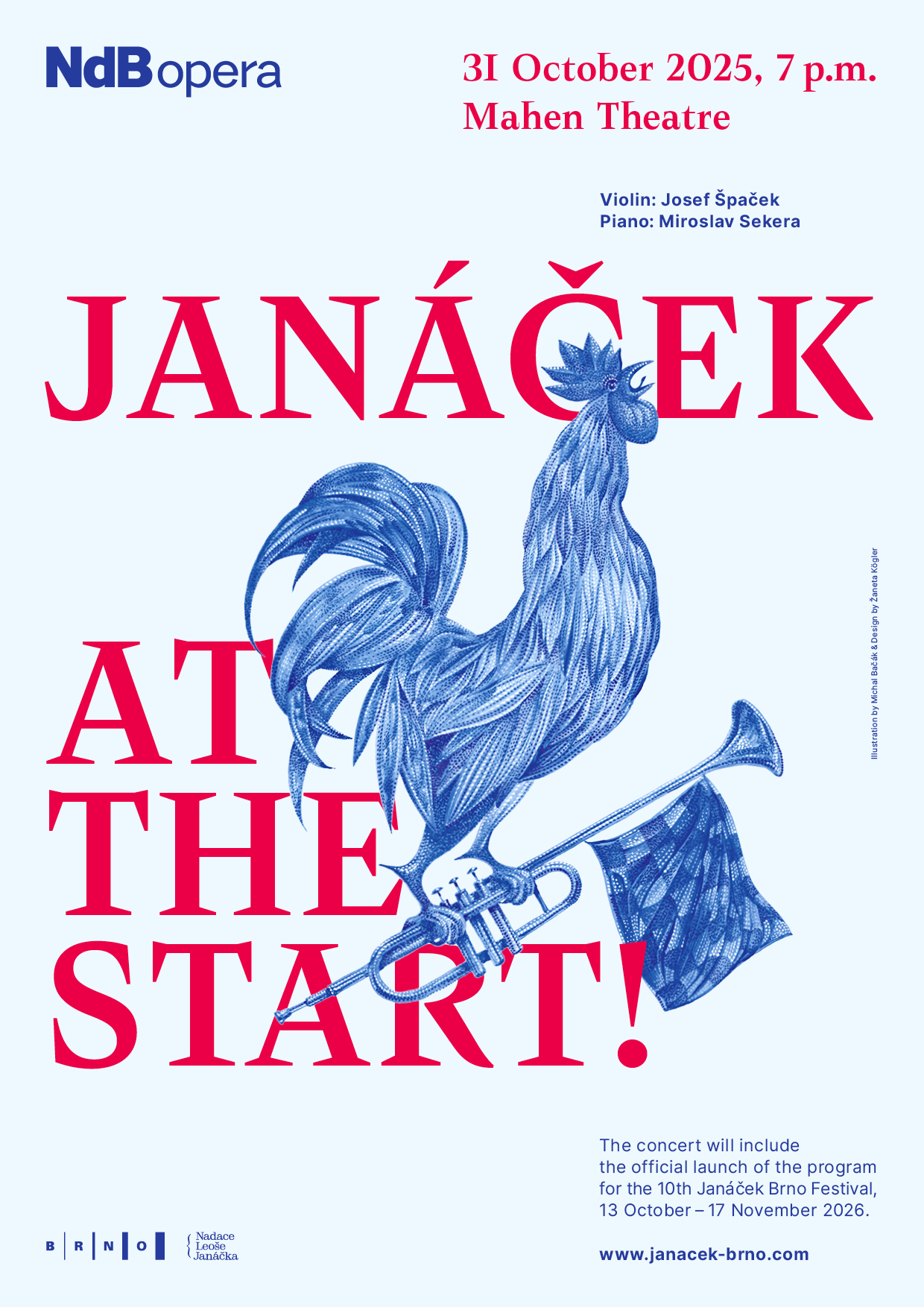
We warmly invite you to a concert by the exceptional duo of violinist Josef Špaček and pianist Miroslav Sekera, taking place on 31 October 2025 at the Mahen Theatre – the historic venue of the world premieres of Janáček’s operas. Their joint recital will be the highlight of an evening that will also feature the official announcement of the programme and the launch of ticket sales for the 10th edition of the Janáček Brno 2026 festival.
Concert programme:
Jean Sibelius: Four Humoresques for Violin and Orchestra, Op. 89
Leoš Janáček: Sonata for Violin and Piano, JW VII/7
Béla Bartók: Romanian Folk Dances, Sz. 56 (arr. Zoltán Székely)
——
Leoš Janáček: In the Mists, JW VIII/22
Antonín Dvořák: Sonatina in G Major for Violin and Piano, Op. 100, B. 183
The cycle Four Humoresques, Op. 89, for violin and orchestra by Jean Sibelius (1865–1957) was composed in 1917–18. At that time, Finland was embroiled in a bloody war with Russia, forcing the composer to flee his home. Isolated from cultural and social life, he endured a difficult period, but the lyrical, elegant, and dance-like character of the Humoresques seems to allow only distant echoes of his hardship to filter through. Sibelius himself remarked that the Humoresques express “the anxiety of existence occasionally lit up by the sun.” For this concert, they will be performed in an arrangement for violin and piano.
Leoš Janáček (1854–1928) composed his Sonata for Violin and Piano during challenging times in 1914–15, deeply affected by the political situation of the day. He later recalled: “I wrote the violin sonata at the beginning of the war, in 1914, when we were already expecting the Russians in Moravia.” The Ballada—initially conceived as a standalone piece—was the first movement composed, with the remaining movements completed in 1915. Janáček revised the sonata in 1920, and it premiered on 24 April 1922 in Brno at a concert of new Moravian music organized by the Club of Young Moravian Composers. It is considered one of the most significant violin works of the 20th century.
The vibrant rhythms and distinctive musical language of Romanian Folk Dances by Béla Bartók (1881–1945) are rooted in the traditional music of Transylvania. Although originally played on instruments like the violin or pan flute, the melodies were arranged by Bartók in 1915 as a set of six piano miniatures. His friend, Hungarian violinist Zoltán Székely, adapted them for violin and piano in 1925.
Janáček completed his piano cycle In the Mists in April 1912. Just a short time earlier, in 1910, he had moved with his wife and housekeeper into a new home in the garden of the Brno Organ School. Hidden from the world, struggling with self-doubt and immersed in melancholy, he composed his final extensive work for solo piano.
Antonín Dvořák (1841–1904) wrote his Sonatina in G Major for Violin and Piano during his second year as director of the National Conservatory in New York, in late 1893. Marking his 100th opus, he dedicated the work to “my children”—specifically his daughter Otýlie, who played the piano, and his son Antonín, who studied violin. They gave the private premiere of the piece in December 1893 in New York. The sonatina remains one of Dvořák’s most beloved chamber works.