





13. 11. 2026, 8 p.m.
Janáček Theatre
Composer: Leoš Janáček
Conductor: Robert Jindra
Director: Krzysztof Warlikowski
Ensemble: Bayerische Staatsoper
The performance lasts 1 hour and 45 minutes, without intermission.
13. 11. 2026
8 p.m.
Janáček Theatre
Composer: Leoš Janáček
Conductor: Robert Jindra
Director: Krzysztof Warlikowski
Ensemble: Bayerische Staatsoper
The performance lasts 1 hour and 45 minutes, without intermission.
Conductor: Robert Jindra
Director: Krzysztof Warlikowski
Stage Designer: Małgorzata Szczęśniak
Lighting: Felice Ross
Video: Kamil Polak
Choreographer: Claude Bardouil
Chorus: Franz Obermair
Dramaturgy: Christian Longchamp, Lukas Leipfinger
Cast:
Dikoj – Milan Siljanov
Boris – Pavel Černoch
Kabanicha – Violeta Urmana
Tichon – John Daszak
Katya – Corinne Winters
Kudryash – James Ley
Varvara – Ena Pongrac
Kuligin – Thomas Mole
Glasha – Ekaterine Buachidze
Feklusha – Elene Gvritishvili
A Man – Samuel Stopford
A Woman – Natalie Lewis
Act I
A young teacher, Kudryash, admires the wide landscape and the river Volga. The calm afternoon is disrupted by the angry outburst of the merchant Dikoy against his nephew Boris. Kudryash wonders why Boris continues to endure his uncle’s brutality. Boris admits that he is unhappy in Kalinov, but he has no choice: if he wants to secure his grandmother’s inheritance for himself and his sister, he must, according to her will, live with his uncle and bear all his mistreatment until he and his sister reach maturity. His misery is deepened by his hopeless love for a married woman – Katya Kabanova. Katya, too, is unhappy in her marriage. Raised in a loving family, she now has a weak, alcoholic husband and a despotic mother-in-law, Kabanicha, who rules the household mercilessly and hates Katya out of jealousy for Tikhon’s love. Kabanicha orders her son to depart immediately for the market in Kazan, reproaching him for his lack of filial devotion and obedience.
That evening in the Kabanovs’ house, Katya and Varvara are embroidering. Katya recalls the happy days of her youth and confesses that she has secretly fallen in love. The carefree Varvara offers to act as a go-between. Tikhon arrives to bid farewell to his wife. Katya begs him to take her with him, or at least to bind her with an oath. Tikhon does not understand and refuses. Kabanicha supervises their parting and forces Tikhon to humiliate Katya with undignified admonitions.
Act II
Kabanicha scolds Katya for not showing enough sorrow over Tikhon’s departure. Varvara brings a key to the garden gate, stolen from Kabanicha, to use for her meetings with Kudryash. She persuades Katya to take it as well. A drunken Dikoy arrives to plead for Kabanicha’s favor.
In the ravine behind the Kabanovs’ garden, Varvara meets Kudryash. At Varvara’s invitation, Boris also arrives. Katya struggles against her desire for Boris, but at last she falls into his arms.
Act III
A violent storm breaks over the town. People seek shelter in a ruined, burnt-out monastery. Kudryash takes the opportunity to suggest to Dikoy that the town should install lightning conductors, but Dikoy sees the storm as a sign of God’s wrath and dismisses Kudryash’s idea with insults. Varvara seeks out Boris, telling him that ever since Tikhon’s return, Katya has been behaving like someone out of her mind. The Kabanov family also seeks refuge in the ruins. Terrified by the storm, Katya publicly confesses her adultery with Boris. Kabanicha triumphs. Tikhon wants to forgive Katya, but she flees.
Glasha and Tichon search in vain for Katya. Varvara is also determined to leave the family home and agrees with Kudrjas to elope to Moscow. Katya goes to the banks of the Volga having made up her mind that the only freedom from her unbearable life is death, but wishes to say farewell to Boris. He arrives with the news that his uncle has sent him to run his business in Siberia, and after his departure Katya throws herself into the depths of the Volga.
In Leoš Janáček’s opera Katya Kabanova, the title heroine is trapped in a dark web of human relationships. Her domineering mother-in-law Kabanicha controls her son Tichon, whose marriage to Katya suffers under this tyranny. Finding no fulfilment within this family, Katya turns to a secret love affair with Boris.
As his own librettist, Janáček condensed the plot of Alexander N. Ostrovsky’s play The Storm, deliberately omitting broader social depictions. Instead, he created a musical language of exceptional psychological sensitivity that traces Katya’s inner development. Feelings of guilt and emotional torment intensify until they culminate in her public confession — an emotional storm that sweeps everything away.
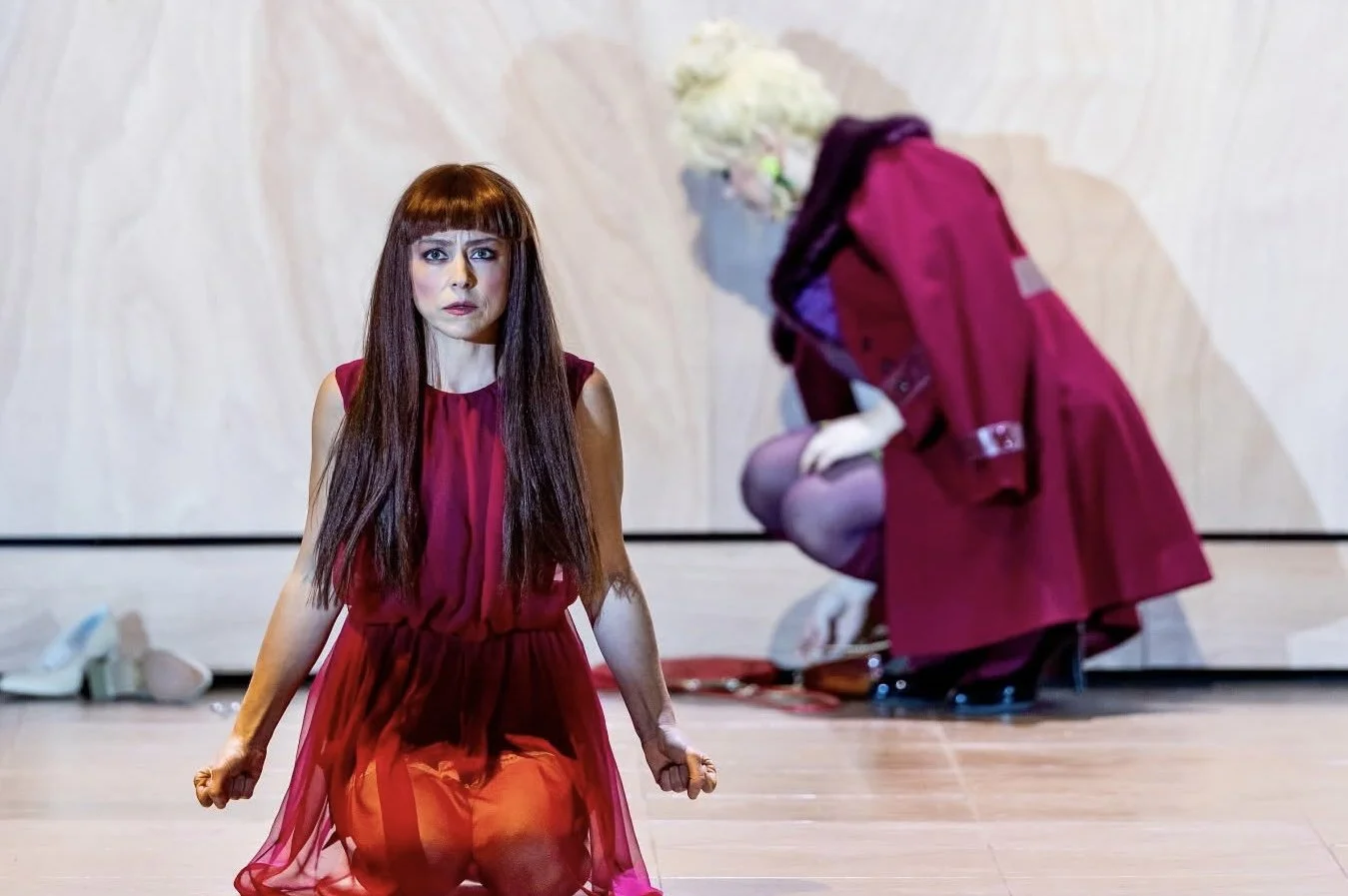
Stage director Krzysztof Warlikowski portrays Katya as an outsider, denied the chance to live according to her desires — a woman who ultimately chooses death over a life of hypocrisy. In this Munich production, the stage design, lighting, and video projections amplify Katya’s inner landscape and the social constraints that surround her.
Premiere: March 6, 2024, Bavarian State Opera, Munich
Conductor:
Director: Krzysztof Warlikowski
Stage Designer: Małgorzata Szczęśniak
Lighting: Felice Ross
Video: Kamil Polak
Choreographer: Claude Bardouil
Chorus: Franz Obermair
Dramaturgy: Christian Longchamp, Lukas Leipfinger
Cast:
Dikoj – Milan Siljanov
Boris – Pavel Černoch
Kabanicha – Violeta Urmana
Tichon – John Daszak
Katya – Corinne Winters
Kudryash – James Ley
Varvara – Ena Pongrac
Kuligin – Thomas Mole
Glasha – Ekaterine Buachidze
Feklusha – Elene Gvritishvili
A Man – Samuel Stopford
A Woman – Natalie Lewis
Act I
A young teacher, Kudryash, admires the wide landscape and the river Volga. The calm afternoon is disrupted by the angry outburst of the merchant Dikoy against his nephew Boris. Kudryash wonders why Boris continues to endure his uncle’s brutality. Boris admits that he is unhappy in Kalinov, but he has no choice: if he wants to secure his grandmother’s inheritance for himself and his sister, he must, according to her will, live with his uncle and bear all his mistreatment until he and his sister reach maturity. His misery is deepened by his hopeless love for a married woman – Katya Kabanova. Katya, too, is unhappy in her marriage. Raised in a loving family, she now has a weak, alcoholic husband and a despotic mother-in-law, Kabanicha, who rules the household mercilessly and hates Katya out of jealousy for Tikhon’s love. Kabanicha orders her son to depart immediately for the market in Kazan, reproaching him for his lack of filial devotion and obedience.
That evening in the Kabanovs’ house, Katya and Varvara are embroidering. Katya recalls the happy days of her youth and confesses that she has secretly fallen in love. The carefree Varvara offers to act as a go-between. Tikhon arrives to bid farewell to his wife. Katya begs him to take her with him, or at least to bind her with an oath. Tikhon does not understand and refuses. Kabanicha supervises their parting and forces Tikhon to humiliate Katya with undignified admonitions.
Act II
Kabanicha scolds Katya for not showing enough sorrow over Tikhon’s departure. Varvara brings a key to the garden gate, stolen from Kabanicha, to use for her meetings with Kudryash. She persuades Katya to take it as well. A drunken Dikoy arrives to plead for Kabanicha’s favor.
In the ravine behind the Kabanovs’ garden, Varvara meets Kudryash. At Varvara’s invitation, Boris also arrives. Katya struggles against her desire for Boris, but at last she falls into his arms.
Act III
A violent storm breaks over the town. People seek shelter in a ruined, burnt-out monastery. Kudryash takes the opportunity to suggest to Dikoy that the town should install lightning conductors, but Dikoy sees the storm as a sign of God’s wrath and dismisses Kudryash’s idea with insults. Varvara seeks out Boris, telling him that ever since Tikhon’s return, Katya has been behaving like someone out of her mind. The Kabanov family also seeks refuge in the ruins. Terrified by the storm, Katya publicly confesses her adultery with Boris. Kabanicha triumphs. Tikhon wants to forgive Katya, but she flees.
In Leoš Janáček’s opera, Kát’a Kabanová, the eponymous heroine is ensnared at the heart of an ominous mesh of relations. Her domineering mother-in-law, Kabanicha, oppresses and controls her son Tichon, whose marriage to Kát’a suffers massively from heteronomy. Because Kát’a finds no fulfilment in this family, she flees and fulfils her unsatisfied erotic desires in an affair with Boris. As composer and librettist, Janáček bundles the plot of the literary template, Alexander N. Ostrovsky’s drama, The Storm. The libretto largely dispenses with the portrayal of the external social circumstances, from whence Kát’a’s essence and choices are decisively determined. Instead, Janáček traces the development of the title character in a psychological-sensitive musical language. Kát’a’s feelings of guilt increase continuously until they discharge into a public confession as an emotional storm. The turbulent and in places fanciful music opens the space for passages of lyrical grace and allows us to experience the essence of the characters. In Kát’a, director Krzysztof Warlikowski sees an outsider, who is denied a life in harmony with her desires, and at the end prefers death over lies. The destructive power of religion behind it all is not only found in a small Russian town on the banks of the Volga in the 1860s, where the libretto places the plot, but rather can also be seen everywhere all over the world.